





Within the Health Crisis Use Case, the objective of the epidemiological scenario was to analyse the spatiotemporal dynamics of epidemic processes. To this end, an epidemic simulator, EpiSim.jl[1], was developed to enable users to simulate and analyse the epidemic dynamics. The simulator, developed by Barcelona Supercomputing Center, is built on top of the MMCACovid19[2] model developed by Universitat Rovira i Virgili (URV) and integrates phone-based mobility data and real-world epidemiological time-series.
EpiSim.jl supports group-specific epidemiological parameters and region-to-region mobility patterns and allows the implementation and evaluation of both non-pharmaceutical interventions and vaccination campaigns.
Complementary tools to support analyses
To support large-scale and advanced analyses, several complementary tools were developed:
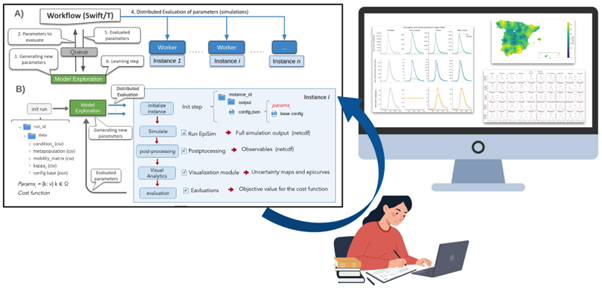
- episim-emews[3]
A workflow that couples EpiSim.jl with the EMEWS framework, enabling the parallel execution of large numbers of simulations on high-performance computing (HPC) infrastructure. This workflow facilitates efficient exploration of high-dimensional parameter spaces through:
- Parameter sweeping, where predefined sets of parameters are evaluated
- Optimisation-based exploration, where parameters are iteratively refined using machine learning algorithms such as Genetic Algorithms (GA) or Covariance Matrix Adaptation Evolution Strategy (CMA-ES)
This workflow is fully customizable and supports uncertainty assessment using visual analytics tools, enabling interactive learning, through user-driven analysis between successive experiments.
- episim-rl[4]
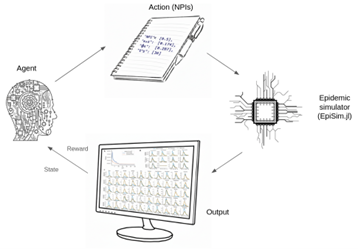
A framework that integrates EpiSim.jl with reinforcement learning techniques. It trains a Q-learning agent to identify optimal strategies for dynamic non-pharmaceutical interventions strategies, such as confinement and mobility reduction policies.
- episim-models[5]
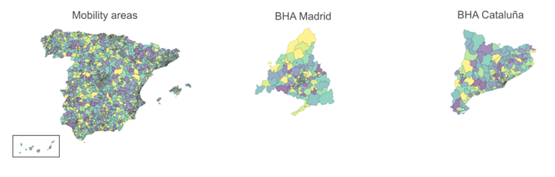
A collection of metapopulation models covering the entire Spanish territory, as well as specific regions like Catalonia or Madrid, at multiple spatial aggregation levels. All models are provided in the format required by EpiSim.jl.
A huge potential to support decision-making during epidemic crises
Using the episim-emews workflow, previously unknown epidemiological parameters were calibrated by fitting simulations to observed mortality, hospitalisation and incidence data. This demonstrated the workflow’s ability to effectively explore complex, high-dimensional parameter spaces and showed that interactive learning significantly improves the calibration. In addition, this framework was then used to design and assess effective vaccination campaigns by analysing the impact of variations in the start date, duration, and age-based prioritisation. These studies confirmed that episim-emews can be effectively applied to the design, evaluate and optimisation of both vaccination and confinement strategies.

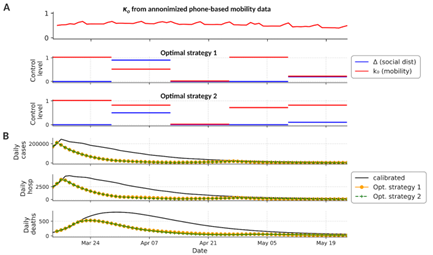
Finally, through the episim-rl workflow, the Q-learning agent successfully identified optimal confinement and mobility reduction strategies that control the epidemic outbreak while balancing the socio-economic cost. These results demonstrate the agent’s ability to learn effective, interpretable, and adaptive intervention policies, highlighting its potential to support data-driven decision-making during epidemic crises.
References
[1] M. Ponce-de-Leon, L. Knox and I. Martínez, “EpiSim.jl Simulator CREXDATA Release V0.2.3”. Zenodo, Nov. 07, 2025. doi: 10.5281/zenodo.17552713.
[2] A. Arenas et al., ‘Modeling the Spatiotemporal Epidemic Spreading of COVID-19 and the Impact of Mobility and Social Distancing Interventions’, Phys. Rev. X, vol. 10, no. 4, p. 041055, Dec. 2020, doi: 10.1103/PhysRevX.10.041055.
[3] M. Ponce-de-Leon and I. Martínez, “Epi-Sim/episim-emews: EpiSim-EMEWS CREXDATA Release”. Zenodo, Nov. 07, 2025. doi: 10.5281/zenodo.17553481.
[4] M. Ponce-de-Leon, I. Martínez and C. Akasiadis, “Epi-Sim/episim-rl: EpiSim-RL CREXDATA Release”. Zenodo, Nov. 07, 2025. doi: 10.5281/zenodo.17553313.
[5] M. Ponce-de-Leon and I. Martínez., ‘EpiSim-Models CREXDATA Release’. Zenodo, Nov. 6, 2025. doi:10.5281/zenodo.17544616.