





Crexdata has focused on two main scenarios for modelling health crisis: Epidemiological Modelling and Multiscale Infection Scenario.
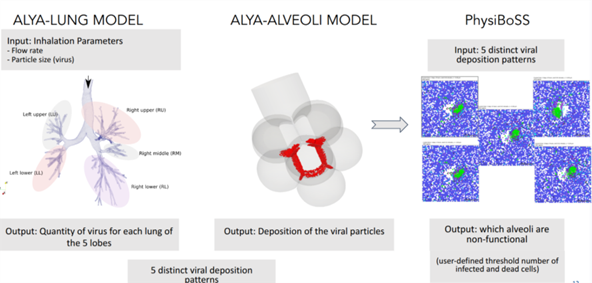
In this case, the Multiscale Infection Scenario, led by Barcelona Supercomputing Center partner, combines agent-based cellular infection models with high-performance computing (HPC) workflows to simulate how viral dynamics, immune response, and tissue damage evolve over time. The approach bridges traditionally disconnected scales: intracellular viral replication, cell–cell interactions in lung tissue, and emergent system-level outcomes relevant to clinical and policy decisions.
At the core of the scenario is a mechanistic lung infection model, implemented using PhysiCell/PhysiBoSS technology, which captures:
- Viral uptake and replication at the cellular level
- Immune cell recruitment and activation
- Tissue-level damage and recovery patterns
This enables the creation of silico lung digital twins, where alternative parameter sets and intervention strategies can be explored systematically.
Scalable workflows for rapid exploration
Rather than embedding the simulator as a static component, CREXDATA integrates it through Python-driven execution workflows, allowing rapid iteration and flexible reconfiguration without recompiling model code. These workflows are orchestrated on HPC infrastructure and support:
- Large parameter sweeps
- Iterative multi-round simulations
- Automated post-processing and analytics
This design proved essential for exploring complex infection dynamics under uncertainty, while maintaining reproducibility and scalability across hundreds to thousands of simulations runs.
Key results from Task 2.2
The evaluation of the Multiscale Infection Scenario demonstrates several concrete outcomes:
- Identification of effective parameter regimes that reduce infection severity and tissue damage, supporting KPI targets related to intervention forecasting.
- Early classification of infection trajectories, enabling separation of efficient vs. dysfunctional tissue responses using time-series features derived from cell-state dynamics.
- Reduction of simulation cost, as interactive and early stopping strategies allow meaningful conclusions with fewer full simulations.
Together, these results show how mechanistic modelling can move beyond descriptive simulation toward actionable decision support.
From research to decision support
Beyond technical validation, expert users highlighted the value of:
- Transparent, explainable mechanistic models
- Visual analytics for comparing alternative infection outcomes
- Flexible workflows that adapt to evolving hypotheses
These insights guided refinements toward user-centric design and informed how multiscale models can complement epidemiological forecasting within the broader CREXDATA Health Crisis Use Case.